
When bulky stock or equipment needs moving between locations, or containers regularly travel through a warehouse, smaller boxes aren't always practical. However, choosing the biggest container isn't necessarily the answer either. Capacity must be balanced against handling, available space and how it will fit in with operations.
© Solent Plastics
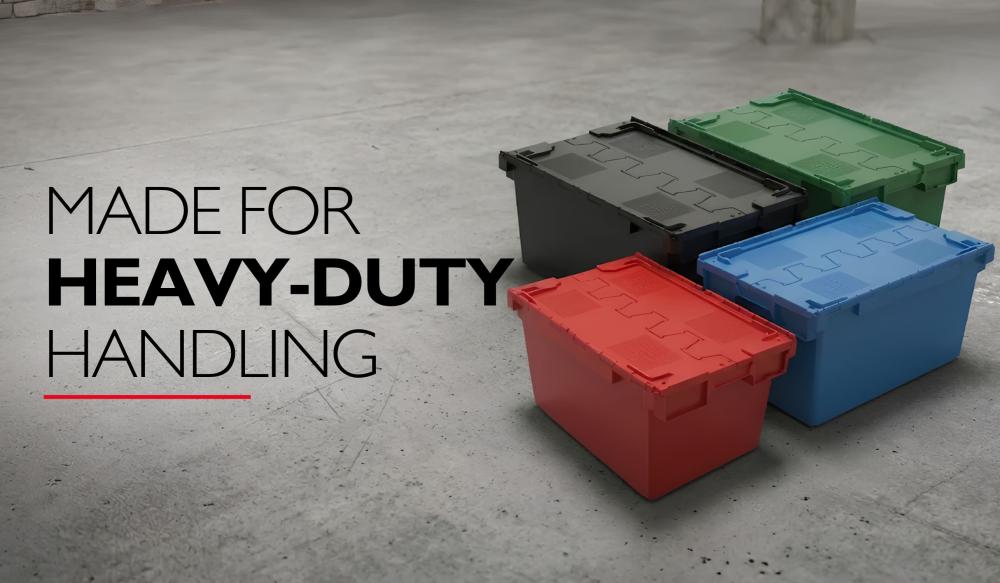
Made from virgin polypropylene, Solent Plastics' 80 litre container provides substantial capacity, without being impractical for common storage and distribution tasks. Better still, all four colours are now back in stock, and we’re selling them at the cheapest price in the UK.
Is the container the right size for me?
Choosing heavy-duty storage containers should start with considering their size. This model has a spacious capacity and measures 710 x 460 x 368mm externally. Internally, there's 605 x 385 x 335mm of usable space. Each container weighs 4kg and has a maximum individual load capacity of 25kg.
These dimensions make it suitable for a broad range of applications including warehousing, retail distribution, logistics, manufacturing, events, equipment storage and removals. It's also popular as a dive box for storing wet equipment as an alternative to a Gear Gulper.
Why choose an attached lid container?
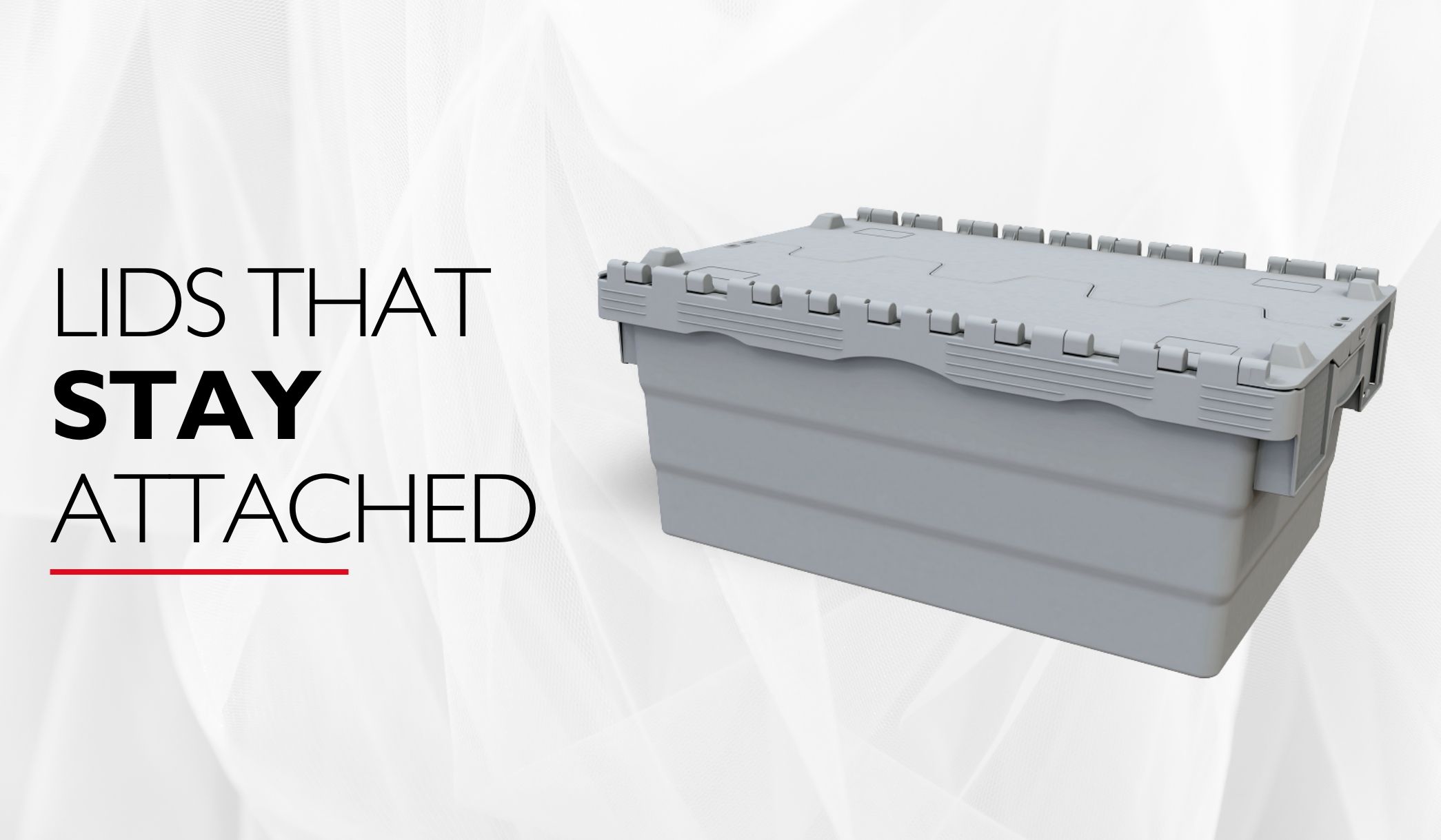
Loose lids have an inconvenient habit of becoming separated from the box.
Unlike ventilated crates, our attached lid container has smooth sides and a solid base with no drainage holes, making it suitable for use with automated conveyor systems. Ergonomic handgrips assist with manual handling. Manufactured from virgin polypropylene rather than recycled plastic, it’s an extremely heavy-duty container for applications where a sturdy reusable tote is required.
Making better use of space
An integral part of choosing warehouse storage solutions is what happens to containers when they're empty. One that works perfectly when filled can become inconvenient if dozens, or hundreds, of empty units require storage or return transportation.
Our 80-litre totes tackle the issue in two different ways. When the lids are closed, the containers can be stacked securely, making use of vertical space when filled or stored. They have a maximum stated stacked load of 300kg. When empty with the lids open, they can nest inside one another. With a nesting ratio of 79%, the amount of space occupied by a group of empty containers can be substantially reduced.
In closed-loop distribution systems, when containers leave a warehouse filled with goods before returning empty, nesting the empty units means return journeys don't require the same volume of vehicle space as the outward journey.
Colours can be more than a cosmetic choice
Our heavy-duty plastic container is available in blue, green, black and red. For some businesses, colour will simply be a matter of preference. For others, having several options creates an opportunity to utilise a visual identification system. Different colours could distinguish stock categories, departments, production stages, workstations or despatch destinations. A warehouse might use one colour for one workflow and another elsewhere, while a manufacturing operation could separate components intended for different areas.
There doesn't need to be a universal meaning assigned to each colour. What's important is consistency within the individual business. When employees understand the system, colour can provide an immediate visual cue before labels or documentation are checked.
While price naturally matters when buying storage boxes, the practical question is whether the container fits the process and its anticipated longevity. Our boxes are always built to last.
Could your current storage be working harder?
Storage requirements rarely remain static, as stock changes, product ranges expand, workspaces are reorganised and processes that once made sense can gradually become less efficient. This makes it worth periodically looking at existing containers with fresh eyes. Are they still the right dimensions for what's being stored? Are empty boxes occupying more room than they need to? Has the way stock moves around the business changed since the storage system was introduced?
In some cases, exploring different capacities, formats or types of heavy-duty storage containers can reveal a better fit for how your operations work.