
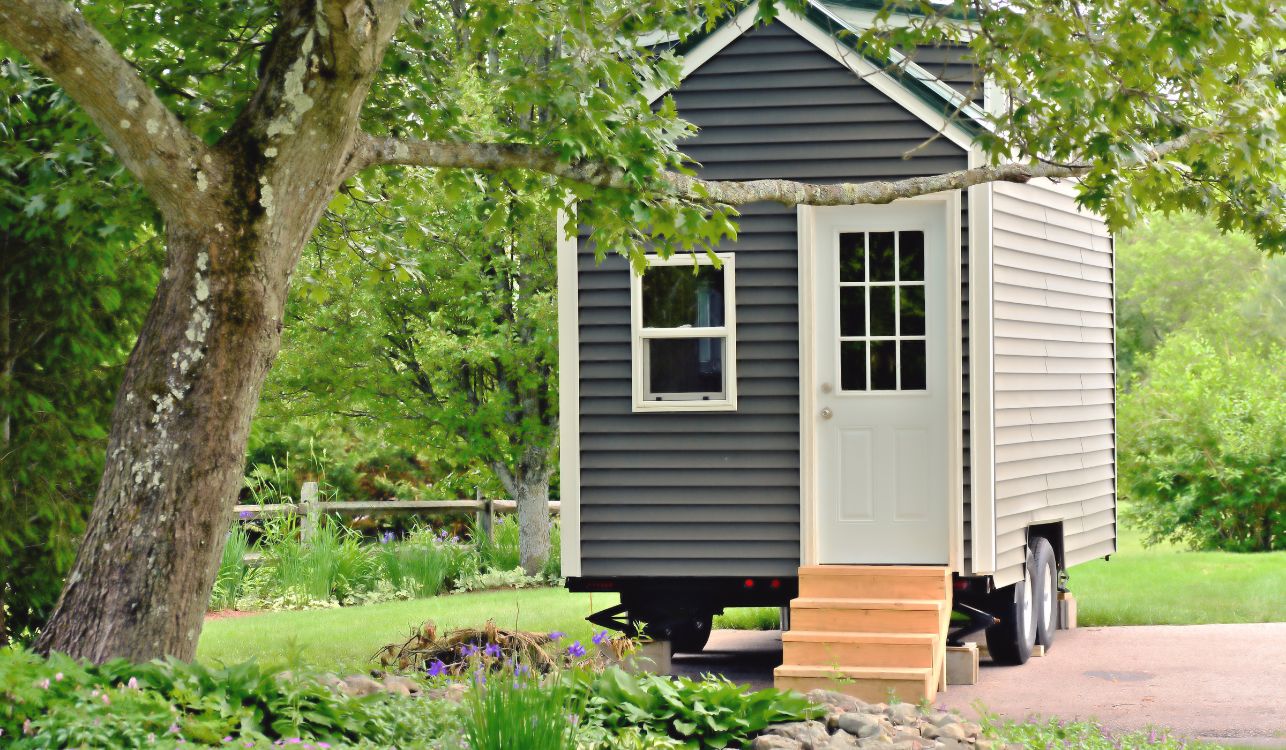
© Lowphoto / Shutterstock.com
This represents a significant increase in the number of people looking for a smaller property, rising from 32% in 2022, according to research by Hamptons estate agents.
Why are tiny homes becoming popular?
The trend towards tiny homes is mostly about saving money, as the average homeowner saves 29% of their budget by choosing a property with fewer bedrooms. Downsizing by three bedrooms can save you a massive 53%, compared with 24% if you downsize by one bedroom.
Apart from being cheaper to buy and run, tiny homes fascinate us, as they give us a chance to test our interior design skills. They also require less furniture, so they’re not as costly to furnish.
Council tax is less on a smaller property, which is easier to maintain and keep clean. Reducing your carbon footprint, a compact and bijou abode is also more environmentally friendly.
Television programmes like George Clarke’s Amazing Spaces on Channel 4 show us what can be achieved with the tiniest homes, fuelling the fire for even smaller dwellings.
Disadvantages of tiny homes
Of course, they’re not without their disadvantages. It can be almost impossible to have guests to stay, as the smallest homes are only big enough for one person. Also, they’re not ideal for pets that need space, such as dogs, so in many cases, they’re built for just one adult living alone.
They can be unsuitable for a person with disabilities, or one who is less able-bodied due to age, as navigating narrow staircases, or a compact bathroom, can be challenging.
Smallest homes around the world
Keret House in Warsaw, Poland, has an interior space of just 46sq. ft. At some points, the interior is only 2.5ft wide. Built in 2012 and measuring 4ft at its widest point, it is 30ft tall, giving it an unusual appearance.
Jakub Szczęsny, an architect and artist, designed the house as a place for artists to stay when they felt creative, describing it as an “art installation”. It was built in a small gap between two existing buildings.
Known as the world’s narrowest house, it has an extremely tall staircase, with a bathroom and furniture including a small bed, desk and shelves. Today, it’s owned by the Polish Modern Art Foundation and doesn’t have a permanent inhabitant.
In the US, Tumbleweed Tiny Homes are a range of eco-friendly, portable homes manufactured in Sonoma, California. Measuring between 65sq. ft and 887sq. ft, they can be attached to a trailer and moved to wherever the owner chooses. The first home in 1999 was called The Elm, but today, there are different models and customers can help design their own property.
Tumbleweed was founded by Jay Shafer, originally to make chicken coops and sheds, but he expanded into timber houses and launched the Small House Society in 2002.
The Vicky Won house in Luling, Texas, USA, is an Airbnb holiday home, measuring just 17ft x 10ft. Based on a Victorian design, it has a loft bedroom with a queen-size bed and a twin-bed on the ground floor. Its open floor plan also features a kitchen, shower, WC, armchair and seats on the veranda to enjoy the rural views. Guests use it as a retreat from modern life, as it has no Wi-Fi or television.
Smallest houses in Britain
The smallest house in Britain, the Quay House, is in Conwy, Wales. Built in the 16th century, it has been named by Guinness World Records as Britain’s smallest house, measuring 122 inches high, 72 inches wide and 120 inches deep.
Situated on the quay, it had one resident called Robert Jones, a 6ft 3 ins fisherman, who had to move out because the ceiling was so low, he couldn’t stand up! It is still owned by descendants of the original landlord today.
The house had occupants until 1900, but has now become a tourist attraction, immortalised on social media all over the world. With a floor area of 10ft x 5ft 10 ins, it has a living area downstairs, where there’s an open coal fire and a water tap. Upstairs is a tiny bedroom with a small storage area.
In the UK, the Tiny Eco Homes company was launched by Chris March in 2009 to provide a range of environmentally friendly tiny houses, measuring 16ft x 8ft. Like their American counterparts, they come with a range of standard features, with buyers also having the chance to add some custom designs of their own.
Importance of storage space
Good organisation is important in every home, but especially in tiny houses. Adequate home storage space not only keeps your living area tidy, clean and hygienic, but it also helps reduce stress. Psychologists say living in an untidy home can cause anxiety, so keeping organised creates a calming, more tranquil environment, where we don’t feel guilty about the mess.
If you live in a small home or flat, underbed storage can be the solution. Solent Plastics’ 33-litre clear extra-long under-bed storage box on wheels is a convenient way of storing items such as clothing, shoes, towels and bedding. Available in three sizes, it can be used under queen, double and single beds. The wheels mean you can easily pull it out, even when full, without hurting your back.
Living in a small space means you can also extend storage space vertically to utilise every corner. Our tower storage unit on wheels, containing three 15-litre plastic drawers, means you can see what’s inside. It’s also easy to move. A portable solution for every room in the house, it can store small items of clothing, jewellery, kitchen utensils, toiletries, paperwork and almost anything else.
Our latest storage range includes a pack of eight clear plastic storage boxes with an innovative air control system. The lid’s design protects the contents from dust, while it can be turned 180 degrees for ventilation to prevent moisture from accumulating inside. Ideal for storing small items, such as clothing, shoes, belts, electronics equipment and keepsakes, a clear lid and base allows you to see what’s inside.
With the appropriate storage solutions, living in a tiny home can be done!