
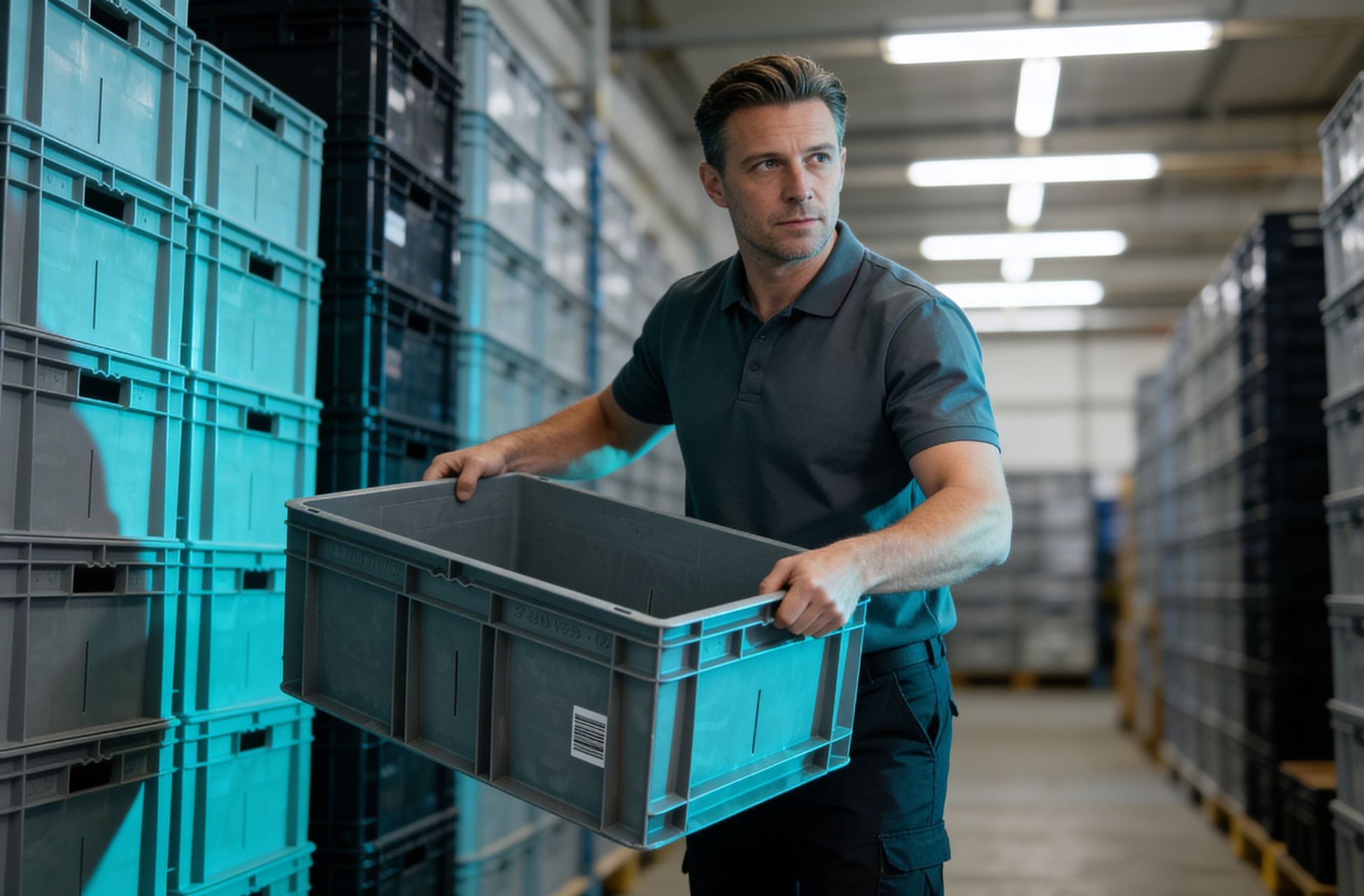
Plastic storage containers, bins and boxes used in such a busy environment must be durable, lightweight and able to withstand demanding working conditions – they are key components of today’s warehouse operations.
© Solent Plastics
Inevitably, as the use of plastic storage grows, so does the conversation around its environmental impact. We’re all increasingly aware that sustainability is not just about packaging or transport emissions: it also includes the materials used in everyday operations, as well as the warehouse processes that support logistics behind the scenes. Understanding how plastic is manufactured, reused and recycled is an important part of running any responsible business.
The growing role of plastic in modern industry
Compared with cardboard or wooden alternatives, plastic containers offer a longer lifespan and better protection for goods in transit or storage. Resistant to moisture, chemicals and general wear, they are well suited to situations where they are expected to perform again and again.
Plastic made up less than 1% of Britain’s waste in 1960. By 2012, this figure had risen to around 12%, reflecting how widely the material is used across industries and households alike. As of early 2026, projections and recent data indicate the UK continues to generate significant amounts of plastic waste, totalling around 2.3 million tonnes per year, with a recycling rate of around 52%.
As e-commerce, manufacturing and distribution networks expand, businesses rely on more plastic storage solutions to contain products safely. The challenge isn’t necessarily their use, but more how they are managed throughout their entire lifecycle. Containers are often used thousands of times, which makes them extremely efficient from operational and sustainability perspectives.
Waste challenges in large warehouse environments
Warehouses operate on a large scale, and storage containers are regularly handled by forklifts, conveyors and manual picking systems. Over months or years of constant use, some containers inevitably become cracked, damaged or unsuitable for continued use. Unlike organic materials, plastic can take decades to degrade, and during that time may break down into smaller fragments known as microplastics that can enter soil and waterways.
Another issue is the sheer volume of storage equipment used across large distribution centres. A single warehouse can hold thousands of storage containers at any given time. Replacing even a small percentage of these each year can generate a considerable amount of waste if the materials aren’t recycled or reused.
For warehouse managers, improving sustainability means looking beyond day-to-day efficiency and thinking more carefully about how materials flow through the complete operation.
The environmental benefits of plastic reuse
Recycling conserves natural resources such as petroleum, natural gas, coal and water, all of which are used in the production of new plastic materials. It also requires significantly less energy than manufacturing plastic from raw materials. Recycling helps reduce pressure on landfill sites, while allowing materials to be repurposed into new products. Recycled materials can be transformed into new containers, tanks or bins that perform the same function as those made from virgin alternatives.
Designed to last for decades, depending on how they’re used; when businesses reuse plastic containers repeatedly throughout their lifespan, this significantly reduces the need to manufacture new units, lowering the environmental footprint associated with production and transport. In practice, the most sustainable approach combines both reuse and recycling.
The UK Plastic Packaging Tax 2022 mandates that packaging, including containers, must contain at least 30% recycled materials or it will be subject to a tax. This initiative is significantly pushing businesses towards recycled options.
Why is plastic preferred over cardboard in heavy use environments?
Cardboard is seen as an eco-friendly alternative, but that reputation doesn’t always hold up under scrutiny. It sounds ideal, as it’s recyclable and feels more natural, being made from trees. The reality is more complicated.
Global demand for cardboard is enormous, requiring vast amounts of timber. Much of this comes from managed forests, but these are often monoculture plantations that lack biodiversity and displace natural ecosystems. In some cases, forests are cleared specifically to grow fast-producing trees for paper and pulp, raising concerns about deforestation and habitat loss.
The production process is resource-heavy involving pulping, treating, pressing and drying, all of which consume significant amounts of water and energy. Even recycled cardboard goes through a similar process, so the environmental cost doesn’t disappear.
Then there’s lifespan. In a warehouse, cardboard doesn’t hold up well. It weakens under pressure, is easily damaged by moisture and can’t withstand repeated handling. That means it needs to be replaced frequently, creating a continuous cycle of production, transport and recycling that adds up over time.
The estimated cost of making just one cardboard box suitable for warehouse storage can cost on average £4, depending on material quality. While this may sound cheap, imagine the cost multiplied millions of times globally given the sheer volume required.
Transport is often overlooked, as the timber or pulp may be shipped across countries or continents before being turned into packaging. Finished products can travel further to reach distribution centres. While not every box has a globetrotting journey, the supply chain can be surprisingly international, with each leg adding to its carbon footprint.
What about other materials?
Other materials come with their own environmental compromises. Wood, for instance, is heavier than plastic, increasing emissions during transport. It can also require chemical treatments to resist pests and moisture, and like cardboard, its sustainability depends on how responsibly it is sourced. Metal offers impressive durability and can be reused for long periods, yet its production is extremely energy-intensive, involving mining and high-temperature processing that carry significant environmental costs.
Extending the life of storage equipment
Plastic storage boxes are often replaced because they no longer meet the requirements of a particular operation, although in many cases, they can still serve a useful purpose elsewhere.
Used plastic boxes, crates and containers offer a practical and cost-effective storage option for businesses that don’t require new equipment. This approach reflects the core principles of the circular economy.
Sustainability beyond the warehouse floor
Logistics and delivery also play a role in the overall environmental impact. Transport networks, courier services and distribution systems all contribute to carbon emissions, which means we must consider how our supply chains operate. Many logistics providers are working towards net-zero targets and investing in cleaner transport technologies in order to reduce emissions over time.
Plastic is set to remain a central part of warehouse storage for the foreseeable future. The key challenge is ensuring that it is used responsibly throughout its lifespan. Sustainability is essential, so adopting a more responsible approach now means industry can continue to operate efficiently while contributing to a responsible future.