
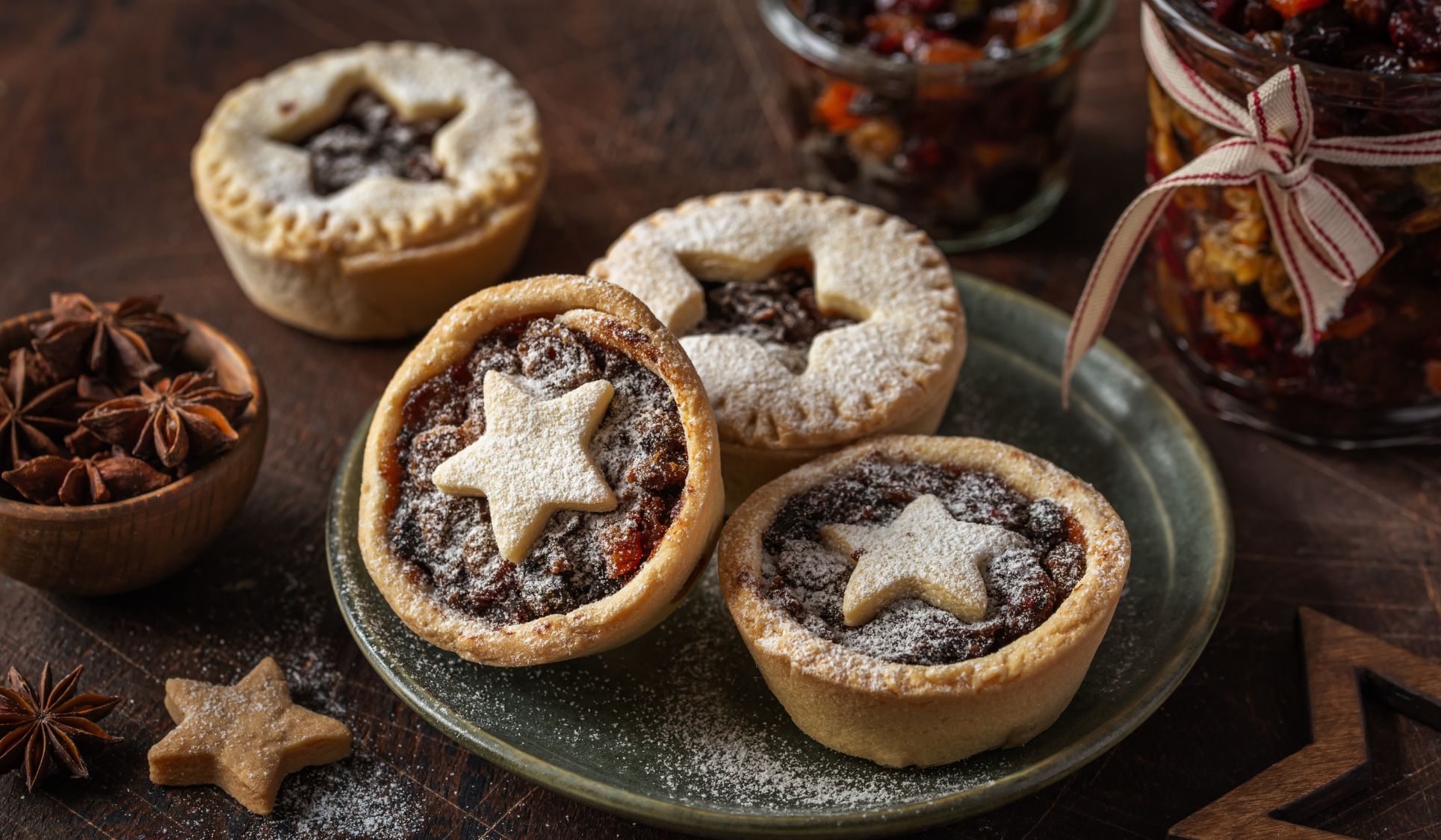
Mince pies are deeply embedded in British Christmas tradition, but while we know them as small, sweet, fruit-filled pastries, the original pies contained finely chopped meat. Their roots stretch back to medieval England, when they resulted from Crusaders returning from the Holy Land bearing exotic spices and cooking techniques.
© Anna Shepulova / Shutterstock.com
The first mince pies added dried fruits and warming spices to various types of meat, a fusion that was a hallmark of early versions. By Tudor times, they were known as ‘shrid’ or ‘shred’ pies, referring to the shredded or finely chopped ingredients that went into the filling.
Unlike modern bakes, they weren't round, favouring a long shape that resembled baby Jesus’ manger. In some versions, a small pastry figure of Christ was placed on top.
Why are they called mince pies?
The name ‘mince pie’ referred to the early recipes that included minced meat such as mutton, pork, beef or rabbit. Over time, the amount of meat used decreased significantly. By the Victorian era, while the tasty treats remained strongly tied to the festive season, the tradition of mince pies made from real meat had declined significantly.
By the late 19th century, many mincemeat recipes used animal fat such as beef suet, mixed with dried fruit, sugar and warming spices. Today, the word ‘mincemeat’ is a historical reminder of when actual meat was a central component, even though this hasn’t been the case for more than a century.
What are mince pies made of today?
Modern mincemeat typically includes a mix of dried fruits such as raisins, currants, prunes and citrus peel; spices such as cinnamon, cloves, nutmeg and saffron; sugar and suet. Thanks to preservation methods and the use of high-spice content, these pies can keep fresh for a considerable time - a practical trait from the days before modern refrigeration. Today, suet is often replaced with vegetable-based fats, making many mincemeat mixtures entirely vegetarian.
Mince pies contain perishable fillings, so it’s important to keep them fresh over Christmas and beyond.
A brief history of the ingredients
The earliest recorded recipe appears in a 14th-century English cookbook called The Forme of Cury. Including pork, hard-boiled eggs, cheese, sugar and saffron, they were a very different flavour from the mince pies of today.
In the 17th century, one recipe described a pie made with a whole leg of mutton alongside dried fruits - a reflection of the mincemeat of the time. By contrast, by the mid-18th century, cookbooks were already featuring meatless mince pies. Hannah Glasse’s Art of Cookery in 1747 included a recipe relying entirely on fruit, suet, sugar and citrus peel.
Food writers of the 19th century supported both meat-based and vegetarian versions, but by the early 20th century, the meat had disappeared and beef suet was being replaced by plant-based fats.
Curious case of the ‘illegal’ Christmas mince pie
You may have heard the rumour that eating a mince pie on Christmas Day is, or used to be, illegal. During the mid-17th century, under Puritan rule, Parliament imposed a national fast on 25th December 1644, meaning celebratory foods like mince pies were technically discouraged on that particular day. However, there was never a law that explicitly named mince pies as being a banned dish. Rather, they were part of the broader crackdown on Christmas celebrations.
When the monarchy was restored in 1660, the fasting laws were repealed, and mince pies returned to their rightful place.
From traditional to trendy
While the traditional mince pie remains a nostalgic favourite, in recent decades, people have been getting creative. The sweet treat has evolved remarkably, with imaginative bakers experimenting with everything from different pastry types to unexpected flavour pairings.
One popular twist is the marzipan and orange mince pie, where a frangipane layer brings a nutty sweetness and orange zest adds a citrus lift. Some choose a richer pastry, or even swap in all-butter shortcrust for a more indulgent base.
The experimentation doesn't stop there. There are even deep-fried mince pies, inspired by fast-food favourites like apple and cinnamon pies, where a crispy, golden crust gives way to a piping hot, juicy filling. Then there are ice-cream sandwiches, made by smashing up mince pies and folding them into vanilla ice cream, sandwiched between two shortbread biscuits in a luxurious homage to the classic.
For history buffs, there’s even a throwback: recipes resurrected from as far back as 1591 include mutton, suet, saffron, mace and dried fruits. These ‘real mince pies’ offer a taste of how rustic the original culinary experience was, compared with today’s sweet, compact versions.
All these mince pie variations show just how flexible the concept is. Whether you want something deeply traditional or wildly modern, there’s a version to suit. The humble mince pie is not static. Its evolution reflects shifting tastes, the availability of ingredients and creativity in the kitchen.
The fact that people are still reinventing it is a testament to its power to inspire. That little pastry this Christmas may seem simple, but it carries with its centuries of history, symbolism and joy!